
Pulling the Thread: What Happened When Christianity Rejected Church Authority
Pontius Pilate looked Truth right in its eyes and didn’t even know it. Jesus Christ proclaimed that He is the Truth. But once Christ returned to the Father, another question became unavoidable: where does authority in Christianity reside, and who has the right to determine what Christ actually taught?  Jesus said to him, “I am the way, and the truth, and the life; no one comes to the Father but by me. (John 14:6). The deeper question behind the Reformation is not merely which doctrines Luther rejected. It asks who has authority to determine Christian doctrine.
Truth is not subject to personal feelings. How you or I feel about something has nothing to do with whether or not it is true. Whether we grasp the formula or not, the truth stays unchanged. 2+2=4 is correct, independent of personal beliefs.
The atheist clinging to his own feelings is blinded to the truth of God entirely. Similarly, the Protestant clinging to his own feelings is partially blind to the fullness of Jesus Christ found in his Church. Eph 5:23 states the husband is the head of the wife as Christ is the head of the church. Both are heretics, the latter closer to the truth but still not quite there. A bride can only have one spouse, and Christ founded one Church. The Church has as its source (God the Father), its founder (God the Son), and its soul (God the Holy Spirit).
God, in order to redeem his people, sent his son, Jesus Christ, into the world. Jesus, who never wrote a single thing, could have gone straight to the cross had God chosen. Instead, he spent 3 years gathering Apostles whom he would instruct to teach others, promising them that they would be guided by the Holy Spirit and would not fail in transmitting his eternal truth. This is called Apostolic Succession. It’s the authority in Christianity.
Most debates about Christianity focus on isolated doctrines. But the deeper issue is authority itself. Who did Christ authorize to teach in His name? Who preserved the faith? Who canonized Scripture? These are the questions explored in my book Catholics Are Wrong? Says Who?, which examines the authority crisis at the heart of modern Christianity.
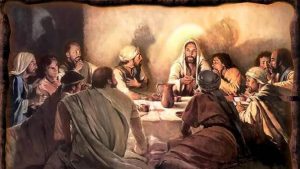
The Bible illustrates how apostolic succession preserves true doctrine. Paul instructed Timothy to entrust what he had heard from Paul to faithful men who can teach others. 2:2). In this passage he refers to the first three generations of apostolic succession—his own generation, Timothy’s generation, and the generation Timothy will teach.
All authority in heaven and on earth belongs to Jesus. Go therefore and make disciples of all nations, baptizing them in the name of the Father and of the Son and of the Holy Spirit, teaching them to observe all that I have commanded you. And behold, I am with you always, to the end of the age.” (Matt 28:18-20)
From its founding to today, men have quarreled about doctrine. The early Christians, however, had no difficulty determining what was true doctrine; they traced the Apostles’ claims.
Martin Luther, a Catholic monk, faced both personal difficulties and abuses by Church leaders and began to pull on the loose thread in the blanket of the One, Holy, Universal, and Apostolic Church. His movement, commonly referred to as the “Reformation, was in fact no reformation at all and a lie. The idea of a reformation implies someone restored the church to its original state. There was no Apostolic teaching to return to, only Luther’s own ideas, which resulted in a brand-new theology. What Luther actually did was start a revolution.
The real issue is not whether Luther protested abuses. The issue is whether Christ gave any individual the authority to redefine Christianity apart from the Church He established. That question — more than any isolated doctrine — is the central focus of my book Catholics Are Wrong? Says Who?
Thousands have followed in Luther’s footsteps, pulling the thread further and further, now left holding one piece, one shred of truth, ma king themselves the author of truth. Denying long-held doctrines and creating their own theology has resulted in thousands of new Christian denominations, each staking a claim to the same Holy Spirit whom Christ promised to his one Church, and each claiming to teach the same eternal truth. Even if Luther was right, his teachings do not form a single cohesive body today; bits scatter across the battlefield. Today, there are more than 30,000 denominations, and that number continues to grow.
Authority in Christianity and Apostolic Succession
Logic tells the reasonable man that truth does not contradict itself, since God is truth itself and his son Jesus revealed that truth to man; only one Church can possess the fullness of such a truth and cannot lie. A lie always contains a certain amount of truth; 2+2=3 is just a little less than the truth of 4, and 2+2=5 is just a bit more than the truth of 4. The unreasonable man clings to his own feelings, grasping a portion of truth, unwilling to move towards the whole truth, in deference to his feelings.
 Jesus said his Church would be “the light of the world.” He then noted that “a city set on a hill cannot be hid” (Matt. 5:14). This means his Church is a visible organization. It must have characteristics that clearly identify it and that distinguish it from other churches. Jesus promised, “I will build my Church and the gates of hell will not prevail against it” (Matt. 16:18). This means his Church will never be destroyed or fall away from him. His Church will survive until his return.
Jesus Christ, God himself, sees the world as it truly is; there is no confusion. His One, Holy, Catholic, and Apostolic Church proclaims that truth as he promised it would.
Pingback: Did Jesus Allow Divorce for Adultery? | Why Catholic